 Billings Egress Windows
 Window Well Installation and Replacement in Billings
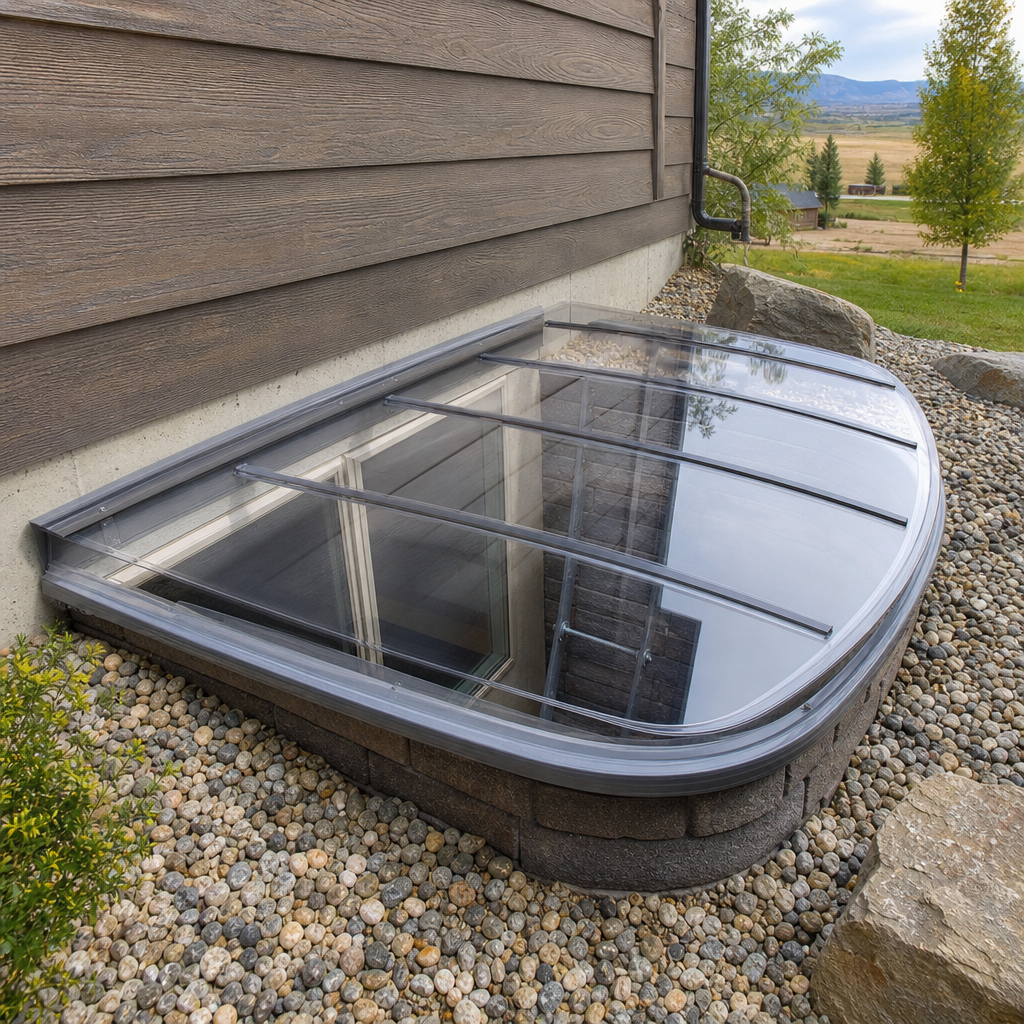
A window well is the pit outside a below-grade egress window that gives the window room to open and a person room to climb out. Under IRC R310, adopted in Montana’s 2021 residential code, an egress well must provide at least 9 square feet of horizontal area, at least 36 inches wide and 36 inches out from the wall, with a permanent ladder or steps if it is deeper than 44 inches. In Billings, a new well as part of a full egress install is included in the $3,500 to $6,500 job price; replacing a failed well in an existing opening runs $1,000 to $3,000.
The well is code, not decoration. An undersized well fails inspection as surely as an undersized window, and a well with no drainage fails your basement.
Why Billings wells fail
Three things kill wells here, and most failing wells involve at least two.
Age. The corrugated galvanized wells set outside the split-levels and bi-levels that filled the Heights from the 1970s through the 1990s are now 30 to 50 years old. Galvanizing gives up at the soil line first, and the rust-through shows up as an orange band a few inches below grade. Once the steel goes, the well bows inward under soil pressure and pulls its anchors out of the wall.
Soil. The USDA soil survey for Yellowstone County counts about 82,000 acres of saline, saline-sodic, or sodic soils, and describes what sodium does to clay: the clay disperses, permeability goes slow, and shrink-swell potential goes high. Ground that swells when wet and shrinks when dry works a well back and forth every year. Add the 36-inch frost depth Billings designs to and you get frost heave on top of shrink-swell. Wells that were set straight in 1985 lean now.
Water. The valley terraces between Billings and Laurel are mapped as silty clay loams and silty clays over stratified clay. On the flood plains the survey puts the water table within 60 inches of the surface, with flooding at snowmelt. Most homes sit higher than that, but a well cut into slow clay with no gravel bed collects every drop from the roof edge above it. A well that fills in April is not a well problem. It is a drainage problem wearing a well costume.
What a proper install looks like
1. Dig out and inspect. The old well comes out and the dig goes a foot or more below the planned bottom of the new one. This is when it becomes clear whether the house has a footing drain and whether it still moves water. Homes built after the 1970s usually have one; older South Side and Central homes may not, or the original tile may have silted shut decades ago.
2. Build the drainage. A washed-gravel bed below the 36-inch frost line, wrapped in filter fabric so the clay cannot migrate in and choke it. Where a working footing drain exists, the bed ties into it. Where it does not, a gravel dry well gets dug deep enough to hold a real storm and let it soak away. This is where the money is, and it is the part a low bid leaves out. The full argument is on the covers and drainage page.
3. Set and anchor the well. The new well sits on the gravel bed, plumb and tight to the foundation, and gets anchored to the concrete with masonry fasteners, not just held by backfill. It should be sized to beat 9 square feet and 36 by 36 with margin so the window sash clears the well wall at full open.
4. Ladder if required. Past 44 inches of depth, a permanent ladder or steps: rungs at least 12 inches wide, projecting at least 3 inches from the wall, no more than 18 inches on center. Bolted through, not hooked over.
5. Backfill and grade. Backfill in lifts, compacted, with the finished grade sloping away from the well and the house. Downspouts get extended past the well; a downspout emptying beside a window well is the single most common cause of the “it floods every storm” complaint.
6. Cover, optionally. A clear polycarbonate cover keeps snow, leaves, and animals out and lets light in. Code requires that it release from inside without tools or keys; anything bolted down is out.
Choosing the well material
| Material | Typical cost band | Life | Notes |
|---|---|---|---|
| Galvanized corrugated steel | Low end of $1,000 to $3,000 | 15 to 25 years | The Billings default for decades; rusts at the soil line |
| Composite or polyethylene | Middle | Decades | No rust, lighter, takes frost movement well |
| Stone-look modular | High end | Decades | Terraced look, doubles as steps, the premium pick for a visible spot |
For a well on the back of a Heights bi-level that nobody sees, corrugated steel with a real gravel bed is money well spent. For a well beside the front walk of a West End two-story, composite or stone-look earns its price.
When a well is part of an egress install
On a full egress installation, the well goes in right after the window is set, on top of drainage built into the same excavation. The dig is already 5 to 6 feet deep for the cut, so the gravel bed and any drain-tile tie-in are done in the same hole. That is one reason the full job is priced as a package rather than window plus well plus drainage as three line items.
Outside Billings
Laurel homes go through the City of Laurel building department. Lockwood, Shepherd, Huntley, and Columbus have no residential building permit, because Yellowstone County issues none outside Billings, the state exempts dwellings under five units, and neither Columbus nor Stillwater County runs a local program. A replacement well in an existing opening is not permitted work in most cases anyway, but every well should still meet the R310 numbers so it passes the only inspection that is guaranteed to happen: the one before the next sale.
Timing and price
Wells are outdoor, below-grade work, so they follow the excavation calendar: reliably March through November, with chinook thaws opening occasional winter windows that nobody can promise. Fall is busy with pre-listing work, so a well that failed this spring is best booked by late summer.
Typical replacement runs $1,000 to $3,000, itemized on the pricing page. Ask about doing two wells in one visit; the second shares mobilization. We cover Billings plus Laurel, Lockwood, Shepherd, Huntley, and Columbus. Request the free on-site measure to find out whether your well needs replacing, or just needs somewhere for the water to go.
Frequently Asked Questions
How big does an egress window well have to be?
IRC R310, as adopted in Montana, requires at least 9 square feet of horizontal area with a minimum 36 inches of width and 36 inches of projection from the wall, so the window can open fully and a person can climb out. If the well is deeper than 44 inches it needs a permanent ladder or steps with rungs at least 12 inches wide, projecting at least 3 inches, spaced no more than 18 inches on center.
What does window well replacement cost in Billings?
$1,000 to $3,000 for a well in an existing opening. Galvanized corrugated steel sits at the low end, composite in the middle, and stone-look modular wells at the top. Depth, whether the gravel bed needs rebuilding, and access all move the number. The measure is free and the quote is flat.
Why does my window well fill with water every spring?
Almost always drainage, not the well. The terraces around Billings are silty clay loams and silty clays that pass water slowly. A well set on bare clay with no gravel bed and no outlet holds snowmelt and May rain like a bucket. Rebuilding the gravel bed below frost and tying it into the footing drain, or a dry well where there is no drain tile, fixes it.
Can you replace a well without touching the window?
Yes, and it is the most common version of this job. The old well is dug out, the drainage rebuilt, a new code-sized well anchored to the foundation, a ladder added if needed, then backfill and grade. The window stays. If the window is also failing, doing both in one visit saves mobilization.